
Key Takeaways
- Connected Living integrates housing, healthcare, wellness, technology, and community
- Normalized products and services reduce stigma and improve adoption
- Strategic partnerships expand access while controlling costs
- High-tech and high-touch models improve outcomes and personalization
- This model supports better wellbeing at price points accessible to the middle market
Forget Senior Living. The future is Connected Living, a holistic model designed for wellspan and financial sustainability.
To address the financial realities and evolving expectations of today’s older American, the traditional senior living industry is ripe for transformation. The future will require an integrated ecosystem that combines housing, healthcare, supportive services, wellness and technology to provide a better experience, with better outcomes, at a
lower cost.
Older adults and those who care for them in all ways whether they be family, friends or hired understand 3 things:
- Older adults see themselves as just people, not older or seniors. They want and will choose to live a life that they consider “normal” akin to their image of themselves, rather than one assigned by others.
- Satisfaction and wellbeing depend on seamless access to services—available when, where, and from whom an individual chooses.
- Services and products should be “normalized”: that is, look and feel like a product or service available to anyone regardless of age or challenge.
What Is Connected Living?
Connected Living is an integrated model of senior wellbeing that combines housing, healthcare, supportive services, wellness, and technology to help older adults live healthier, more connected lives.
Curated Platforms for the Longevity Economy
Joe Coughlin, who heads the MIT Age Lab, speaks often about a curated brand experience. He suggests that products and services targeting the “Longevity Economy” will only gain traction if the brands behind them appeal widely, not just to older adults.
Examples of Technology in Everyday Life
Two examples come to mind: The first is the Apple Watch, which can serve as a personal emergency response system or PERS. Think of it: you are wearing a watch just like everyone else and if you are older, you might also impress your grandchildren. My mother wears one and if she falls, I get a call. More importantly, she can use her watch to call for help. The second is also by Apple. AirPods now can double as hearing aids. Using them does not stigmatize you as an older adult with an age-related challenge.
These branded products relieve stigma and may even offer the user cachet. Sourcing and/or creating these products makes good business sense. But there is more…
Partnership Models for Dining, Care, and Support Services
Curated partnerships are a strategic win for operators: they provide access to highly sought-after services and experiences while avoiding the costs and overhead of staffing them in-house. In this case, think about partnerships for providing care and support or food and beverage. Could today’s dining rooms and kitchens be leased to restaurants who offers meals to both residents and to outside consumers? Limiting the need for the capital outlay associated with a commercial grade kitchen and dining venue reduces risk for new restaurateurs or established vendors who want a quick way to expand. A lease payment offsets the community’s fixed costs, but most importantly it offers “normalized” restaurant experiences for residents that are financially underwritten by the
restaurant rather than the community.
Benefits of Curated Partnerships for Senior Living
A similar partnership model works well for care and supportive services, especially in active adult and independent living communities. Agencies that provide private duty and home health services can benefit from the community setting, as it reduces their staff’s travel time and costs. For residents, this model may also make it possible to purchase services in smaller, more manageable time increments, making them more accessible and affordable. The opportunity to curate “preferred” partnerships is something Juniper has long done through its nationally recognized Connect4Life program.
How Integrated Care Ecosystems Improve Wellbeing in Senior Living
Access to necessary products and services will always be important for the consumer. But in today’s ecosystem, seamless integration is even more critical for both customers and payors. This integrated experience is what empowers individuals to live their best lives, remaining as healthy and vital as possible.
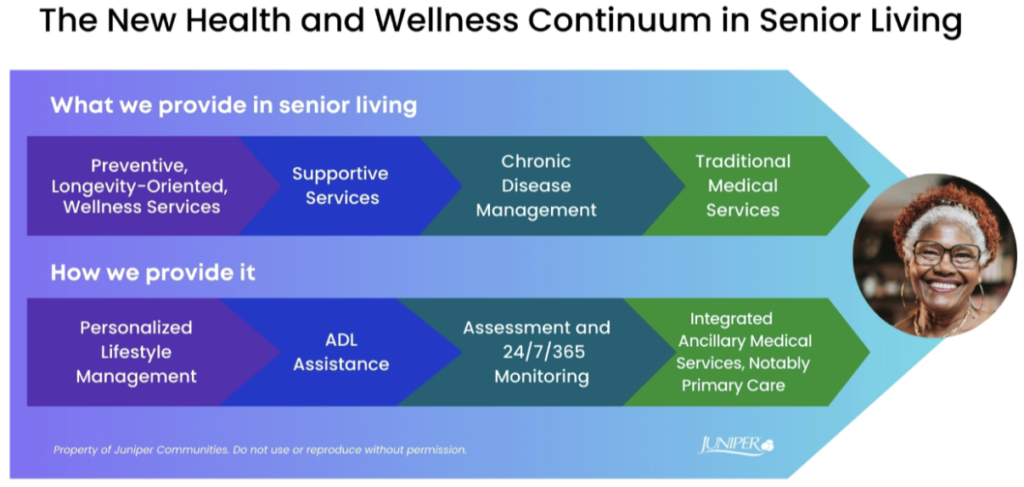
At Juniper, seamless integration is achieved through an approach that we describe as “high-tech” and “high-touch”. A high-tech, cross-functional digital operating system offers access to real-time data and analytics about an individual’s health, wellbeing, and preferences. This gives our team a “single playbook” from which to provide a timely, personalized experience and offer insight to healthcare providers on and off Juniper’s campus. High-touch is the essential human element that brings the technology to life. It means giving customers direct access to an individual who can answer questions, facilitate complex communication, and actively audit the data and communication to ensure the process is working.
At Juniper, this person is called a medical concierge. Their expertise is facilitating healthcare and supportive services to manage chronic disease, reduce unnecessary hospitalizations, and provide a seamless experience for the customer.
Building on the success of the medical concierge model, Juniper is now piloting a new human role to foster “wellspan”—living not only longer but also better, together, in community. We call this individual a lifestyle concierge. This new role will focus on curating a total wellness experience and building personal lifestyle plans to enable a high-value journey for every individual.
The integrated ecosystem has a couple of primary goals. First and foremost, it should deliver a personalized experience, one based on strong, detailed and balanced information designed to meet the goals of the individual. Second, it must show outcomes: it must prove its ability to deliver customer satisfaction as well as wellspan
and the associated clinical outcomes for better care, quality, and financial efficiency.
Changing Language and Attitudes in Senior Living
Words matter. In the case of senior living, they really matter. Ageism is rampant and so engrained that even those of us who others might consider, “senior”, engage in its practice. Changing mindset is tough and requires concerted, and yes, mindful, action.
We need to think before we speak – really. Before we make a joke like “being as good as well-aged wine” or claiming “a senior lapse” when forgetting a name or word, we need to stop ourselves. There is no need to forgive or excuse what is normal. Does a baby seek forgiveness for crying or wetting their pants?
The connotation of “senior living” is generally tied to someone who needs help to live. And for a society that values youthful independence, needing help does not carry positive vibes. Senior living has often also been about segregation of older adults from the broader community rather than one built on intergenerational integration. And
perhaps worst, the two words used together: senior and living, actually evoke not vitality but the steady degradation of functional capacity leading to death.
Connected Living as a More Inclusive Model for Aging
“Connected Living” may be a better way to describe the products, services, and experiences that are evolving for the next generation of consumer. Connected Living is simple: it represents an integrated ecosystem of people and programs, bringing together residents, family members, team members, partners, and the community at large. People require human connection; data needs to be integrated with other data; businesses thrive on partnership; and a community is stronger when it has places, people, and programs to unite it.
Senior Living Affordability and the Forgotten Middle
Whether you call it a tsunami (which breeds terror) or a silver wave (which evokes the natural rhythm of the sea), we can all agree that the number of Americans over 65 is growing. The old demographic pyramid is gone.
Who Is the Forgotten Middle in Senior Living?
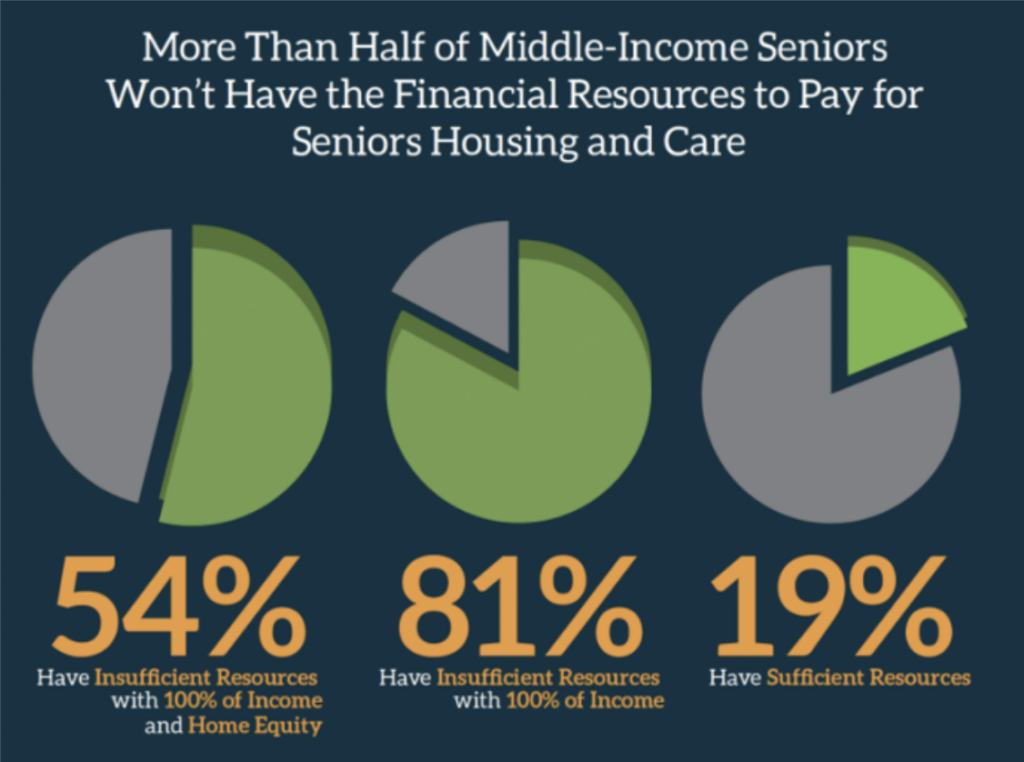
What there is less talk about is the financial capability of today’s older American. This concern was quantified in a landmark study by NORC at the University of Chicago, which identified and characterized “The Forgotten Middle,” a term coined by the National Investment Center for Seniors Housing and Care (NIC). The study revealed that a vast majority of this growing cohort is ill-equipped to afford the housing, care, and services required to support the life they want.
This means the new model of Connected Living needs to evolve to offer new types of housing and access to services.
Connected Living: A New Model for 21st Century All Seasons Life
An ecosystem integrated by data and a common communication platform is the only way to enable a partnership model where services can be provided most efficiently and with highest quality. Fostering a community or “integrating” people—families and members of the community at large—to offer diverse options for housing and experiences, may be the only way to assure a vibrant social fabric at a price point the middle market can support.
Building Community Through Connection and Shared Experiences
Most of us thrive on being part of a community. When people come together in community and share connection whether that be around a social or spiritual or other pursuit, simple magic happens! The desire or perhaps compulsion to support each other grows as does our positive feelings of belonging.
Ultimately, Connected Living is non-negotiable. It is the only way to deliver personalized experiences and measurable outcomes for wellspan by fostering a vibrant social fabric at a price point the middle market can truly support. After all, whether it is “high-tech” or “high touch”, connection is the foundation of a longer, healthier, and a happier life.